





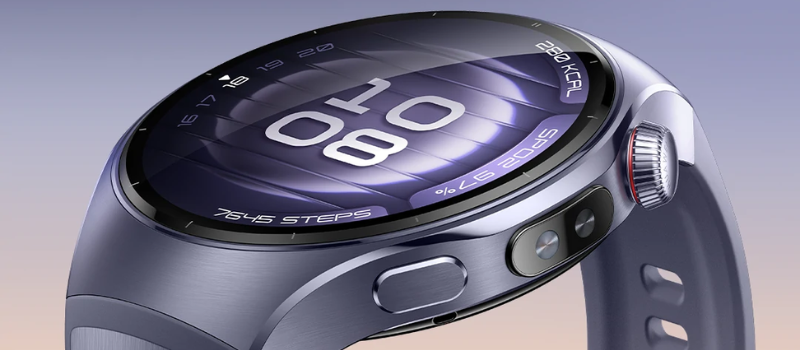
To say that the Huawei Watch 5 is only a smartwatch would be an understatement. This new model from the Chinese brand not only bets on an elegant and modern design, but also integrates health features that, until recently, seemed exclusive to advanced medical devices. The evolution compared to previous versions is clear: more precision, greater battery life, and a much deeper focus on the user's well-being.
What’s interesting about the Huawei Watch 5 isn’t just the technology it incorporates, but how that technology fits into daily routines. From continuous heart-rate monitoring to sleep tracking and stress level, everything is designed to offer useful, understandable, and actionable data. It’s not a watch that merely displays information: it acts as a true personal assistant that helps make healthier decisions.
Moreover, its refreshed operating system enhances the user experience and opens the door to a more seamless integration with other devices. In this review we tell you everything: how it works, what new features it brings, and, above all, whether it truly lives up to being called “the giant” of today’s smartwatches. Ready to get to know it inside out?
A commanding design and premium materials: this is how the Huawei Watch 5 looks
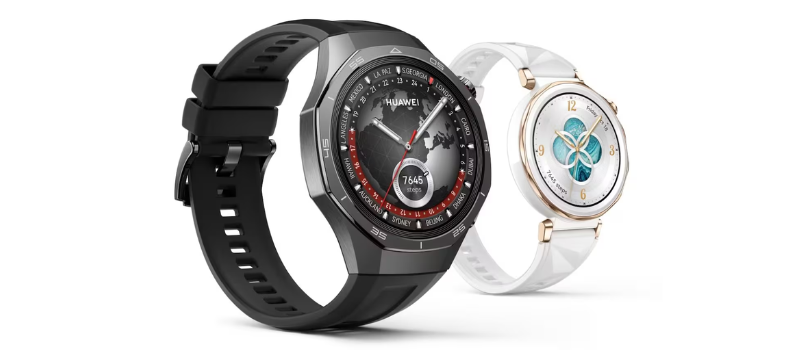
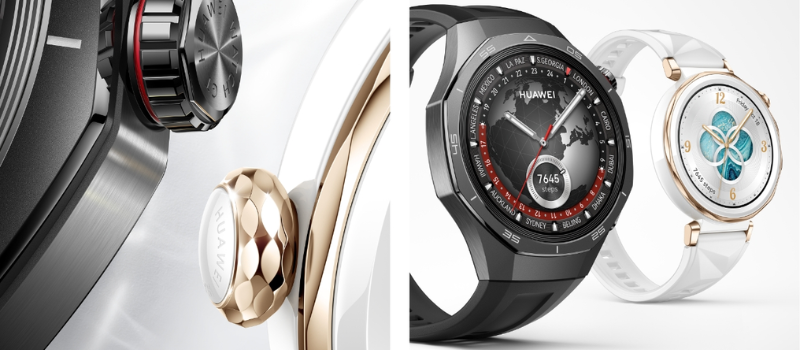
The Huawei Watch 5, unlike the Huawei Watch GT 5, does not go unnoticed. From the first glance, its design conveys strength, sophistication, and a clear intention to position itself as a premium device. Available in two versions, one with a 46 mm case in elegant titanium gray and another more compact 42 mm with a delicate rose-gold finish, this smartwatch shows that aesthetics and functionality can go hand in hand.
The larger model is made from aerospace-grade titanium, a material noticeably lighter than steel —about 45% lighter— but with superior strength. It is up to 1.8 times stronger and 1.5 times harder, which allows for a surprisingly comfortable experience without compromising durability. Meanwhile, the smaller version is built with 904L stainless steel, a material commonly used in high-end watchmaking for its corrosion resistance and bright finish, ideal for those seeking a smartwatch that also doubles as an elegant accessory.
The sapphire crystal display, slightly curved, offers not only a polished aesthetic but also superior scratch resistance. It’s a detail that makes a difference in daily use: you can forget about screen protectors because this glass is ready for anything. The smooth edges and the glossy surface enhance the elegance of the design, and although the 46 mm model may seem large on paper, in practice it feels comfortable thanks to the optimized weight of the titanium.
A detail worth mentioning is the rotating crown. It has a precise haptic response and adds that touch of physical interaction that many users appreciate. However, the overall design may divide opinions: it’s modern, even futuristic, and while that pleases some, others might miss the classic discreteness of earlier generations like the Watch GT 5 Pro. What’s clear is that the Huawei Watch 5 wants to stand out, and it does. It’s not a watch that blends in with the crowd; it demands to be seen.
A screen that dazzles: brightness, fluidity, and detail in every gesture of the new Huawei Watch 5
If there’s one aspect where the Huawei Watch 5 —compared to the Huawei Watch GT 5 Pro— shines, literally, it’s its display. The new generation of this smartwatch has made a notable leap in visual quality, opting for an AMOLED panel with LTPO 2.0 technology that leaves no room for criticism. Brightness reaches peaks of up to 3000 nits, a figure that translates into perfect visibility even in bright daylight. It doesn’t matter if you’re running under the sun or checking a notification outdoors: everything looks clear, vibrant, and with an exceptional level of contrast.
Colors stand out for their intensity, blacks are deep and pure, and the sharpness of text and graphics is outstanding. Moreover, Huawei Watch Fit has managed to reduce the bezels to just 1.8 mm, which raises the screen-to-body ratio to 82.5%. This not only improves the overall aesthetics but also enhances the user experience by making it more immersive and intuitive.
Another advantage is the adaptive refresh rate that adjusts the cadence according to the content shown. Thanks to this feature, animations look smooth and fluid, while energy consumption stays in check. Interaction with the panel is fast, precise, and without delays. Everything responds as it should, from swiping between menus to tapping animated watch faces or controlling health functions.
Additionally, the curved glass that covers the display not only beautifies the overall look but also improves touch and ergonomics. The finger glides naturally, reinforcing that sense of total smoothness sought in a high-end smartwatch. In short, the screen of the Huawei Watch 5 with monitoring is not just a strong point: it’s one of the best reasons to choose this model over the competition.
Invisible power, tangible experience: the performance of the Huawei Watch 5
Although Huawei prefers to keep the technical details of its processor and internal memory secret, the user experience of the Watch 5 speaks for itself. Everything on this watch runs with surprising smoothness, from navigating menus to launching apps. Transitions are smooth, animations unfold without delays, and new AI-based features respond immediately, with no signs of system fatigue.
One of the most notable innovations in connectivity is the integration of eSIM. Thanks to it, the watch can make and receive calls, as well as connect to the internet independently of the phone. This feature is especially useful during sports activities, urban walks, or simply in situations where carrying the phone isn’t convenient. Moreover, with the Wi‑Fi 6 compatibility, download speeds have noticeably increased, allowing you to update the system or download new apps from AppGallery almost instantly.
For sports and adventure enthusiasts, the Watch 5 includes the Sunflower positioning system, a solution that combines several satellites to offer outstanding accuracy, even in complex urban environments or mountainous areas. The ability to use full-color online maps and offline maps broadens its usefulness on outdoor routes without depending on the phone.
But where it truly stands out hardware-wise is with the incorporation of X-TAP technology. This innovation sits on the right side of the watch, replacing the traditional bottom button. The module includes a pressure sensor, an ECG electrode, and a PPG optical sensor, all designed to improve precision in biometric measurements. This configuration allows health checks to be performed faster, more accurately, and with less hassle.
Taken together, the Huawei Watch 5 combines discreet power, efficiency, and advanced features that place it a step ahead of many competitors. Its performance is not only solid but also intelligent.
HarmonyOS in command: lights, shadows, and real advances in the Watch 5 experience
The Huawei Watch 5 arrives with a clear promise: to offer a more complete software experience thanks to HarmonyOS in its full version. And yes, on paper, that translates to eSIM connectivity, expanded access to apps via AppGallery, and greater versatility in features. But once on the wrist, the story is somewhat more nuanced.
The ability to use the watch independently of the phone, thanks to eSIM, is undoubtedly one of the major advantages. Receiving calls, streaming music, or checking maps without needing to carry the phone around provides a greatly valued freedom, especially during sports activities or light commutes. However, this greater autonomy comes with an evident cost: energy consumption. Battery life is compromised compared to lighter software models, such as those in the GT series.
One of the features that truly makes a difference in this version is “Health Glance.” Thanks to the integrated X-TAP technology, the watch allows a health scan in just 60 seconds by placing the finger on the side area. It analyzes up to 9 key indicators, including ECG, heart rate, blood oxygen level (SpO2), skin temperature, heart rate variability (HRV), and even emotional state. Everything is recorded and explained in the HUAWEI Health app. It’s a true pocket check, ideal for users seeking constant and precise monitoring.
Another useful novelty is gesture control. Although not perfect yet, it allows interacting with the watch without touching the screen, especially practical in situations where hands aren’t free. In addition, measuring blood oxygen from the fingertip is noticeably more accurate than the traditional wrist measurement, approaching the performance of clinical pulse oximeters.
However, not everything is perfect. One weakness remains the lack of a fully functional mobile payments solution outside China. Although Huawei is working on alternatives like Quicko, its availability in regions such as Spain remains limited. This leaves the Watch 5 at a disadvantage compared to competitors that already offer fully integrated NFC.
Notification management doesn’t shine either. Although it allows replying to messages from apps like WhatsApp, support for emails or more complex notifications still needs polishing. And although AppGallery has grown, the app catalog still does not match the variety and quality offered by platforms like Wear OS or watchOS.
Precision health and limitless sport: the Watch 5 as trainer and personal doctor
When it comes to caring for health and optimizing physical performance, the Huawei Watch 5 has no direct competition. In this area, the brand has managed to position itself as a reference thanks to an ecosystem of advanced sensors and intelligent features that elevate the smartwatch concept to a new level.
The crown jewel is X-TAP technology, an innovative system located on the right side of the watch that combines a pressure sensor, ECG (electrocardiogram), and PPG (photoplethysmography). This technology allows biometric measurements from the fingertip, with precision that, according to Huawei, rivals professional equipment. The function “Health Glance” — or “Health Snapshot” — is a clear example of what can be achieved with this integration.
In just one minute, and by placing the finger on the sensor for three seconds, the watch measures up to nine key indicators: electrocardiogram, heart rate, blood oxygen saturation (with a measurement in just 10 seconds), skin temperature, stress levels, heart rate variability (HRV), arterial stiffness, respiratory quality, and respiratory awareness during sleep. After the scan, the results are synced with the Huawei Health app, which generates a full report with analyses and personalized recommendations. But the Watch 5 isn’t limited to point-in-time checks. It continuously tracks parameters such as heart rate, oxygen levels, stress, or sleep quality (including stages, interruptions, and possible apneas). Women also have menstrual cycle tracking. All is integrated into “Health Insights,” an intelligent system that detects patterns, relates different metrics, and offers practical tips to improve daily health.
In the realm of sports, the watch is equally capable. With support for more than 100 activities, it covers classics —such as running, swimming, or cycling— up to less common modalities like free diving, golf (with access to real course maps), skiing, triathlon, or team sports. Thanks to the dual-band GNSS Sunflower positioning system and color maps — online and offline — outdoor tracking is extremely accurate. It also includes advanced metrics such as VO2Max, training load, recovery time, and personalized plans. The watch allows importing GPX routes and syncing with platforms like Komoot, making it a true ally for demanding athletes.
Battery life matched to its power: how the Huawei Watch 5 battery performs
When you push advanced features like eSIM connectivity and a full operating system like HarmonyOS, some concessions are inevitable. In the case of the Huawei Watch 5, the sacrifice is especially noticeable in battery life. Unlike the GT-series models — famous for lasting up to two weeks on a single charge — here the battery adapts to a more demanding profile, though not completely disappointing.
Huawei offers two clearly differentiated usage modes. The first, called Standard Mode, activates all the watch’s functionalities: cellular connection, always-on display (AOD), constant health monitoring, and more. In this scenario, the 46 mm model offers about 4.5 days of autonomy, though with AOD active the figure drops to about 3 days. The 42 mm version achieves 3 days, which reduce to 2 if the display is kept on all the time.
For those looking to stretch the battery to the limit, there is the Long-Lasting mode, which preserves essential functions but limits connectivity and certain measurements. With this setup, the large model reaches up to 14 days, though sometimes 11 days of use (7 days typical); the smaller reaches up to 7 days maximum (5 in normal use). Switching from one mode to another is quick and easy, and takes only a few seconds.
In practice, the experience is fairly faithful to what’s promised. With balanced daily use —active notifications, some GPS-enabled exercise, and an AOD display— the 46 mm model typically hovers around exactly 3 days of autonomy. It isn’t a record-breaking figure, but it stays within the reasonable range for a smartwatch this feature-rich.
What is appreciated is the fast charging. The 42 mm model charges fully in just 60 minutes, while the 46 mm does so in 90, using the new included magnetic charger. An important detail: this charger is different from those of previous generations, so it’s worth keeping track of it.
Conclusion: Huawei Watch 5, the balance between innovation and well-being
The Huawei Watch 5 represents a solid step toward the future of smartwatches. It’s not just a pretty or powerful device; it’s a real tool for those who value both design and health, athletic performance, and connectivity. Its combination of premium materials, impressive display, and state-of-the-art sensors positions it as one of the most complete smartwatches available today.
The integration of HarmonyOS in its most advanced version adds extra versatility, enabling features like eSIM, a broader app ecosystem, and smart tools that, although still having room for improvement, are heading in the right direction. Features like Health Glance or the precise SpO2 measurement at the fingertip are true technological jewels that elevate the user experience. It’s true that battery life doesn’t match that of simpler GT models, but it remains more than enough for everyday use for most users, especially if you manage the usage mode well. In exchange, you gain a much richer, more personalized, and useful experience.