





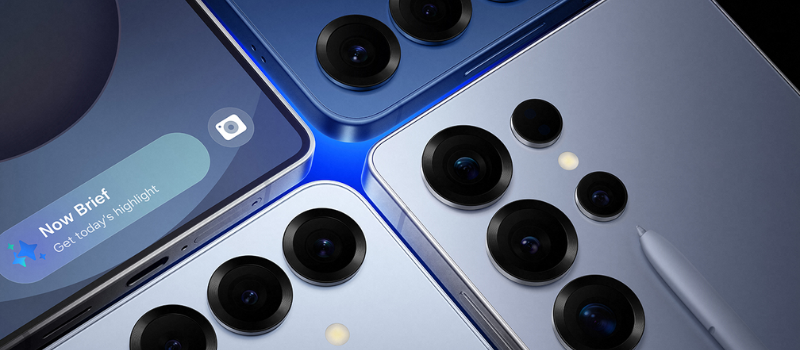
The Samsung Galaxy S25 is already here and, as expected, it has not left anyone indifferent. With each new generation, Samsung raises the bar in design, performance and technology, and this model is no exception. Are you thinking of changing your phone this year? Do you wonder if the Galaxy S25 is really worth it? In this comprehensive analysis we tell you everything you need to know: its most notable novelties, day-to-day performance, strengths and also possible downsides.
In 2025, competition in the high-end segment is fierce, and Samsung knows it. That’s why it has bet on significant improvements in the processor, in the main camera and in the user experience. But… are these changes enough to justify its price? Is there really an evolution compared to the Galaxy S24?
Join us on this journey where we explore in depth every aspect of the Galaxy S25. We also include opinions from real users and an honest comparison against other top smartphones on the market. If you’re looking for a sincere and well-detailed analysis, this article is for you.
Renewed design and a screen that shines: a winning combination in the Samsung Galaxy S25
The first encounter with the Samsung Galaxy S25 leaves no doubt: we are looking at a smartphone that has taken a small turn in its visual identity. Unlike its Ultra version, which opted for slightly more rounded edges, the Galaxy S25 bets on a straighter design, with pronounced lines and a more square silhouette. Although it may seem like a minor change, it is felt immediately when holding it. That angular shape not only gives character, but also improves grip in day-to-day use. Whether watching a series horizontally or pulling it quickly from the pocket, the in-hand feel is more secure.
In terms of build, the finish conveys elegance at first glance. It is light, surprisingly light. With only 162 grams, one might think robustness is sacrificed, but the opposite happens: the Galaxy S25 is solid, comfortable and well balanced. That said, precisely because it is so light, it can slip away easily if the pocket is roomy or shallow. Even so, the grip has noticeably improved compared to previous models. The back has a treatment that resists slipping, even in wet or slightly greasy hands.
The buttons, all located on the right side, are well positioned, with a firm press. At the bottom we find the USB-C port and the SIM tray, all arranged neatly and without surprises.
Now, the screen is another of the main protagonists. Samsung does not disappoint here: the panel AMOLED LTPO Gorilla Glass Victus 2 offers an outstanding visual experience. With a maximum brightness of up to 2,600 nits and an adaptive refresh rate from 1 to 120 Hz, viewing content outdoors is no longer a problem. Even under direct sunlight, visibility is impeccable. Whether you use the phone to watch movies, game, or simply browse, colors are vivid, contrast is deep, and blacks, as usual with Samsung, are intense.
The under-display fingerprint sensor responds quickly and accurately, even if the finger isn't completely dry. To tell the truth, it works so well that it ends up being the favorite unlock option compared to facial recognition, which is also present but less reliable in low-light environments.
In short: the Galaxy S25, unlike the Samsung Galaxy S25 Ultra or the Samsung Galaxy S24 Ultra, not only looks good, but also feels good. A top-tier screen, refined design and details thought for real-world use. A combo that shows that sometimes small changes make a big difference.
Power without limits: analyzing the Galaxy S25 that accelerates like never before
In a market where every year smartphones seem to reach their ceiling, Samsung has decided to break the mold with its Samsung Galaxy S25. Gone are the days when this non-Ultra model felt a rung below in brute power. This 2025, the South Korean brand has leveled the playing field and decided to equip the Galaxy S25 with the same processor as its bigger brother. Yes, we’re talking about the new Snapdragon 8 Elite, and not a generic version. Here we have a tailor-made tuned edition, developed in partnership with Qualcomm to squeeze the last drop of performance.
The result? A device that is no longer limited to being the smallest in the S family, but a true colossus in a compact body. Ideal for those who prefer a manageable screen without sacrificing an inch of speed or power.
Inside the S25 throbs a true beast: the modified Snapdragon 8 Elite includes six Qualcomm Oryon Gen 2 cores that run at 3.5 GHz, and two extra cores capable of reaching up to 4.5 GHz. This architecture positions it as one of the fastest and most efficient ARM processors in today’s mobile world. And if that wasn’t enough, Samsung has added a subtle 100 MHz overclock, a small adjustment on paper, but one that makes a real difference in performance versus other competitors' models.
And not only are we talking about compute power. In the graphics department, the Adreno 830 GPU makes the Galaxy S25 a perfect gaming machine. Demanding games like Genshin Impact or Diablo Immortal run smoothly, with no frame drops or overheating. Moreover, real-time ray tracing is no longer a promise but a tangible reality. Textures, reflections and lighting reach a level that barely a couple of years ago was only possible on high-end consoles or PCs. It’s an immersive experience that surprises every time the screen is turned on.
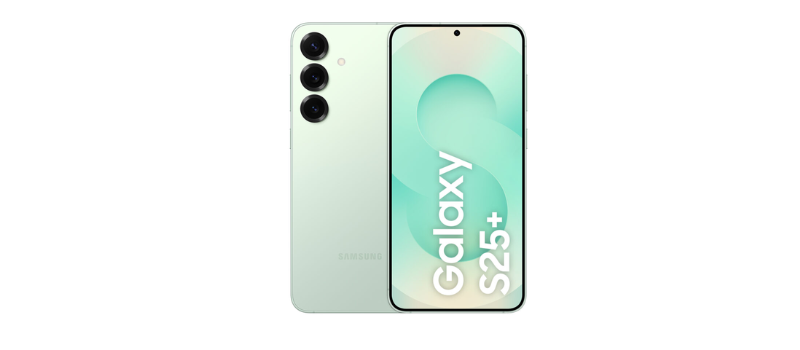
But this doesn’t stop at spectacular graphics or minimum loading times. In the era of artificial intelligence, Samsung has strengthened its bet with a Hexagon NPU of a new generation, 45% more efficient compared to the previous model. And you can tell. Features like automatic voice transcription, simultaneous translations or intelligent photo editing (yes, even removing people from an image with a tap) now happen instantly without needing to connect to cloud servers. Everything is processed on the device itself, ensuring privacy, speed and efficiency.
To this power combo add 12 GB of DDR5X RAM, which allow keeping multiple apps open without the system suffering at all, and 128 GB of UFS 4.0 storage, a lightning-fast read/write technology that makes opening an app or moving heavy files a matter of a sigh. The experience, in short, is smooth, steady and uninterrupted, even under heavy use.
And perhaps the most notable aspect of this technical display is that it does not translate into excessive energy drain. Samsung has found the ideal balance between power and consumption. The Galaxy S25 not only flies, but does so without draining the battery by mid-day. But that, of course, deserves a separate section.
In conclusion, the Galaxy S25 stands out as one of the most powerful phones of 2025, not only for its numbers but for how it feels in practice. It performs, reacts and responds immediately. It is no longer a smaller brother: it’s the new standard of compact power that combines the best of hardware with a smooth and modern user experience. And if productivity, gaming, or simply not wanting limits is your thing, this S25 won’t disappoint you.
Fair but surprisingly effective battery: new Samsung Galaxy S25
When you see that the Samsung Galaxy S25 arrives with only 4,000 mAh of battery, the first thought is: will it really be enough? In a market where the norm already hovers around 5,000 mAh and there are models that even exceed 6,000, Samsung’s figure may seem conservative, even somewhat disappointing on paper. But this is where numbers mislead, because real-world usage tells a different story.
Samsung has chosen to continue using traditional lithium-ion batteries, not yet adopting the new battery technologies that some competitors are starting to explore. It’s a safe bet and perhaps somewhat timid in a segment that moves quickly. However, the good news is that the Galaxy S25’s energy efficiency makes up for that more modest capacity.
Over weeks of heavy use, the S25 has proved to be a reliable companion. With long social media sessions, constant web browsing, photos, videos and a few hours of streaming, it makes it to the end of the day without issue. In most cases, 15-20% battery remains when the day ends. This is less about capacity and more about the excellent optimization between hardware and software, with a Snapdragon 8 Elite that is very consumption-friendly.
That said, on especially demanding days — for example, with heavy gaming or prolonged camera use and GPS navigation — it would be nice to have a bit more capacity to avoid thinking about plugging in in the afternoon.
Where there is clear room for improvement is in fast charging. With a maximum of 25 W wired and 15 W wireless charging, the Galaxy S25 is somewhat behind its direct competitors, many of whom already allow full charges in 40 or even 30 minutes. Here, Samsung maintains a cautious stance, prioritizing battery health and long-term durability, which makes sense from a sustainability perspective. But for the user who needs a quick recharge before leaving the house, this speed may feel insufficient.
In practice, a 30-minute charge recovers approximately 55% of battery, and the full 0-100% cycle is around an hour and fifteen minutes. It’s not dramatic, but not particularly competitive for a premium smartphone in 2025.
In summary, the Galaxy S25 scores well on daily autonomy, thanks to its balance between efficiency and consumption. However, charging speed remains the brand’s Achilles heel, and it’s one of those details that users value more and more. If Samsung can improve this aspect without sacrificing battery lifespan, we’d be talking about an almost perfect experience.
One UI 7 and Artificial Intelligence (AI): the duo that transforms your day-to-day with quality hardware
If there’s something that defines the experience with the Galaxy S25, it’s the perfect harmony between software and hardware. Much of the credit goes to OneUI 7, Samsung’s customization layer that has matured into one of the leading references in the Android ecosystem. With this version, the Korean brand not only polishes aesthetic details: it redefines how we use the phone and how we relate to technology.
From the first contact, OneUI 7 transmits fluidity, order and personality. Unlike other skins that try to resemble stock Android or simply clutter it, here there is a very well-achieved balance. Menus are clearly structured, navigation gestures are natural, and everything is designed so the user finds what they need without complications. In addition, the level of customization is deep: you can leave it as it comes or adapt it completely to your style. The overall feeling is that you are using something yours, unique, not just another phone.
But where OneUI really jumps is in the intelligent integration of AI-powered features. It’s no longer about having a pretty OS, but one that thinks with you. One of the most useful examples is the personalized daily brief, a kind of quiet assistant that each morning clearly shows your tasks, events, trips or reminders. Just take a look while you have breakfast to see how the day looks. And the best part is that it adapts to you: the more you use it, the more refined it becomes.
Another gem is the incorporation of Google AI-based features, such as Circle to Search, developed with Gemini. This tool allows you, by drawing a circle over any image, word or on-screen element, to get contextual information instantly. It’s useful, intuitive and addictive. It doesn’t matter if you’re watching a product in a video or a reference on social media: the S25 is ready to give you answers without you having to leave the app.
All of this is not just digital cosmetics. It’s a philosophy of use. Samsung has understood that today the true value of software is not loading it with unnecessary features, but making it work for you, anticipating your needs, and staying always one step ahead. In that sense, OneUI 7 not only accompanies: it becomes a daily ally that simplifies, organizes and enhances your routine.
In short, with the Galaxy S25 and its OneUI 7, the Android experience reaches a new level. Polished aesthetics, practical intelligence and a constant sense that the phone understands how you live. And that, in a technology-saturated world, makes a real difference.
Samsung Galaxy S25 camera: evolution without risks and a pinch of intelligence
For many users, the camera is one of the deciding factors when choosing a new phone. It’s no accident: today we take more photos than calls, and having a good camera in the pocket has become indispensable. In the case of the Samsung Galaxy S25, the brand has opted for a steady but effective approach, refining what already worked in previous generations rather than reinventing the wheel. The result? A balanced, reliable photographic system with a good dose of AI to improve the experience.
The crown jewel remains the main camera of 50 megapixels, with an f/1.8 aperture and a generously sized sensor. This lens offers an excellent level of sharpness, especially in good light. Photos show a very well-achieved color representation, natural and without exaggerated saturations. When the full 50 MP mode is activated, the level of detail you can capture in well-lit scenes is simply impressive. Perfect for landscapes, urban photos or capturing textures with great precision.
In low-light conditions, the Galaxy S25 holds up better than expected. The combined work of the sensor and AI processing reduces noise without losing detail, offering very good results even indoors or at night. The portrait mode has also improved, with a more precise separation between subject and background, though slight inconsistencies can still be seen in tricky areas like unruly hair or backgrounds with strong lighting.
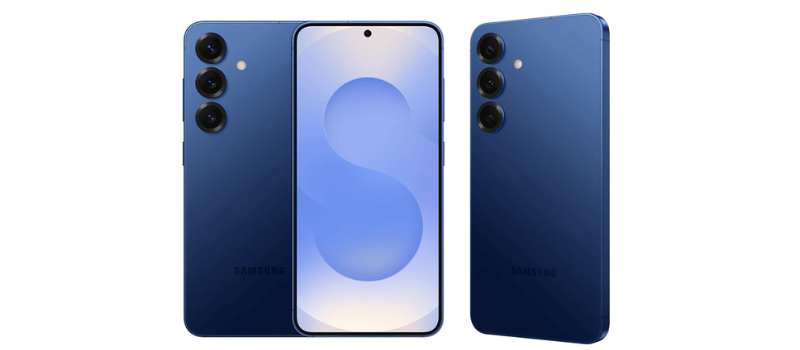
The 12 MP ultra-wide does its job well, though you can notice a drop in quality compared to the main sensor. Edge distortion is still present and in low light you lose detail. Still, for capturing wide spaces or scenes with many people, it works properly and without big surprises.
On the other hand, the 10 MP telephoto with 3x optical zoom is ideal for portraits from a more comfortable distance, achieving pleasing and sharp frames. That said, when you switch to digital zoom, quality begins to drop noticeably from 10x onward, something to be expected but worth noting if you want to capture distant details.
The 12 MP front camera also performs adequately without standing out too much. Selfies come out well-defined and with realistic colors, although in challenging lighting conditions it can overexpose the background. The portrait mode here also works, though—as with most phones—it struggles a bit with recropping edges of glasses or hair with complex shapes.
In short, the Galaxy S25 camera system maintains the level without taking risks, with subtle but effective improvements. The integration of AI adds that plus that makes a difference, making the phone adapt better to each scene. It may not revolutionize the sector, but it offers a solid, versatile photography experience, and above all, very satisfying for day-to-day use.
Conclusion: smart balance for day-to-day life
After a month of intense use, the Samsung Galaxy S25 presents itself as one of the most complete and balanced phones the brand has released in recent times. It doesn’t come to revolutionize the market with big surprises, but to consolidate a winning formula that combines power, design and user experience with enviable maturity.
This model stands out for knowing how to find the right balance in almost everything. It’s powerful without sacrificing energy efficiency, it has a manageable design that doesn't give up high-end features, and it includes a customization layer — OneUI 7 — that truly adds to the whole. Added to this is a very well-judged integration of smart features, making day-to-day life easier and smoother, from personalized summaries to instant visual searches.
Of course it’s not perfect. The battery, although efficient, could have been more generous in capacity, and charging speed lags behind other manufacturers that already bet on much faster solutions. But the truth is, in real use these aspects do not ruin the overall experience.
The Galaxy S25 shines where it matters: in reliability, smoothness, and how it adapts to what the user needs without complications or artifices. It’s a phone that doesn’t tire, that responds well in every situation and that proves innovation can also be about improving what already works.
In short, if you’re looking for a high-end smartphone that doesn’t match the prices or dimensions of Ultra models, but offers the best of Samsung in a comfortable and well-tuned format, this Galaxy S25 is a safe bet. An intelligent mix of today’s best, with nods to the future, but without forgetting what we already know works.